



Improving Postoperative Surgical Wound Dressing Outcomes
 ;
;
Despite advances in surgical techniques, surgical site infections (SSI) and other surgical site complications (SSC) continue to be a challenge to clinicians and researchers across the globe.¹
SSCs and SSIs threaten outcomes in all surgical procedures. However, the right post-op dressing plays an integral role in patient recovery and their healing process.
The advancement of postoperative wound dressings has been driven by practical clinical innovation aimed at reducing complications such as surgical site infection (SSI), dehiscence and blistering.
The Jubilee Method shows reduction in blistering
One such development in the battle against SSCs was the “Jubilee dressing method”. Created at the Golden Jubilee National Hospital in Clydebank, Scotland, where clinicians layered 3–4 Aquacel™ dressings beneath a DuoDERM™ Extra Thin hydrocolloid, an ideal dressing for surgical incisions.²
The Jubilee Method arose after clinicians saw many blisters from traditional adhesive dressings. This led the team to pilot a new multilayer dressing, combining a Hydrofiber™ Aquacel™ layer with DuoDERM™ Extra Thin. This early audit showed a reduction in blistering from 19.5% to 3.5%, prompting broader evaluation of the approach.³
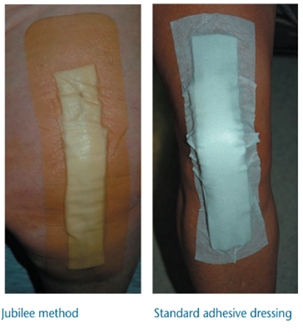
Image from study: The Jubilee method: a modern dressing design which reduces complications and is cost-effective following total hip and knee arthroplasty. Dillon JM, Clarke JV, Emmerson S, Kinninmonth AWG. Department of Orthopaedics, Golden Jubilee National Hospital, Clydebank, Glasgow, Scotland.
A subsequent prospective audit compared the “Jubilee Method” with their traditional adhesive dressing. The results showed a reduction in blistering from 18% to 2%, fewer dressing changes, longer wear times, fewer delays in discharge due to wound issues, and a lower rate of surgical site infection (3% to 1%).
These findings confirmed the clinical advantages of the Hydrofiber™ and hydrocolloid combination and supported its adoption.³
Inspired by these findings, Aquacel™ Surgical and Aquacel™ Ag Surgical were developed to combine the trusted technologies of Aquacel™ Hydrofiber™ technology with DuoDERM™ hydrocolloid, addressing the key challenges of surgical recovery and reducing the risk of blistering.
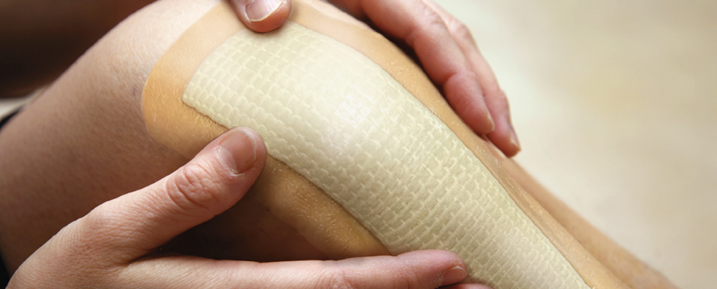
Supporting patients postoperative recovery
The Aquacel Surgical range of wound dressings are designed to offer patients a range of benefits throughout their wound healing recovery process and help to facilitate a reduced length of stay.
Stays in place
Dressings stay in place for up to 7-days helping you to minimise unnecessary dressing changes⁴ to keep the incision undisturbed and promote easier self care.²
Protects against contamination
The occlusive dressing design keeps the incision protected from external contamination and is viral, bacterial and waterproof allowing your patient to shower.⁵
Hydrofiber Technology provides infection control
The fibres within the hydrofiber technology form a cohesive gel, encapsulating large populations of potentially pathogenic bacteria, reducing the risk of infection.⁶
Aquacel Surgical Wound Dressings
Aquacel™ Surgical and Aquacel™ Ag Surgical dressings were developed in response to a defined customer need for a dressing to manage wounds as a result of surgical incision.²
The Aquacel™ Surgical dressing portfolio has a strong clinical heritage in supporting physicians to reduce the harmful consequences of SSCs demonstrated across multiple surgical studies and specialties.
Aquacel™ Ag has the added benefit of ionic silver, that provides rapid and sustained anti-microbial activity and kills a broad range of pathogens within 30 minutes.⁷ Aquacel™ Ag Surgical is highly effective in providing fast and sustained anti-microbial activity against the most common SSI-associated pathogens.⁸
1. Sandy-Hodgetts K et al (2022) Optimising prevention of surgical wound complications: Detection, diagnosis and prediction. London: Wounds International. Available online at: www.woundsinternational.com
2. Product Monograph AQUACEL® Surgical Dressing Portfolio. Data on file, ConvaTec Inc.
3. Clarke JV, Deakin AH, Dillon JM, Emmerson S, Kinninmonth AW. A prospective clinical audit of a new dressing design for lower limb arthroplasty wounds. J Wound Care. 2009 Jan;18(1):5-8, 10-1. doi: 10.12968/jowc.2009.18.1.32128. PMID: 19131911.
4. Springer BD, Beaver WB, Griffin WL, Mason JB, Odum SM. Role of Surgical Dressings in Total Joint Arthroplasty: A Randomized Controlled Trial. Am J Orthop (Belle Mead NJ). 2015 Sep;44(9):415-20.
5. In-Vitro Performance Characteristics of AQUACEL® Ag Advantage Surgical Cover Dressing (SCD) and AQUACEL® Ag Advantage Surgical Cover Dressing (SCD) Slim Profile (SP) WHRI6551 MS171 V1.0. Convatec data on file
6. Walker M, Hobot JA, Newman GR, Bowler PG. Scanning electron microscopic examination of bacterial immobilisation in a carboxymethyl cellulose (Aquacel) and alginate dressings. Biomaterials. 2003;24(5):883 890
7. Jones SA, Bowler PG, Walker M, Parsons D. Controlling wound bioburden with a novel silver‐ containing Hydrofiber dressing. Wound Repair Regen.2004; 12(3): 288‐29
8. Jones S, Bowler PG, Walker M. Antimicrobial activity of silver- containing dressings is influenced by dressing conformability with a wound surface. WOUNDS. 2005;17(9):263-270
AP-79844-GBR-ENG-v1
Blogs
05/09/2024

Wound healing in hard-to-heal cases
Despite advances in dressing technology and best practice, wound care is in crisis. Successful treatment requires an ...
Read more Read more28/08/2024

How to recognise wound biofilm
Spotting biofilm with the naked eye can be a challenge due to its microscopic structure. Knowing how to recognise wou...
Read more Read more27/08/2024

Why is biofilm so resistant?
Read our latest blog to learn what makes biofilm a tricky customer and how the right wound dressing can destroy it.
Read more Read more22/08/2025
What the Latest NICE Guidance Means for Antimicrobial Wound Dressings
The latest evaluation from NICE provides important clarity on the use of topical antimicrobial dressings such as Aqua...
Read more Read more21/10/2025

Lessons from the Wound Hygiene Podcast Series
The Wound Hygiene Bitesize Podcast series explores the four-step protocol of care, designed to simplify and standardi...
Read more Read more17/03/2026

Wound healing: Don't underestimate nutrition
In hard-to-heal wounds, HCPs must look beyond the wound at other factors including comorbidities, socioeconomic chall...
Read more Read more
10/12/2025

Recognising Pressure Ulcers in Darker Skin Tones
Identifying pressure ulcers is key to preventing harm. For patients with darker skin, the signs of pressure damage ca...
Read more Read more20/05/2026

Reducing cardiac surgical site infection: The role of post-op dressing choice
For patients undergoing cardiac operations or surgical procedures, the journey does not end in the operating theatre....
Read more Read more22/05/2026
It Doesn’t Have to Be This Way: Legs Matter Awareness Week
This year’s Legs Matter Week runs from 8–12 June, bringing together patients, healthcare professionals, and system le...
Read more Read more17/06/2026

Standardising dressings: From variation to value in wound care
At a time when the NHS is under increasing pressure to deliver more efficient, evidence-based care, reducing variatio...
Read more Read more